One hundred years ago, when Atlanta built its airport, city leaders had high hopes it would quickly become a top air hub.
Already in the airport’s second year, city council debated spending $50,000 on lights to allow overnight flying — to keep ahead of New Orleans and Memphis.
“Atlanta was an air pioneer, but unless we keep pace with the growth of other cities along this line we will fast lose our prestige,” then-city Alderman William Hartsfield warned in a 1926 Atlanta Journal story.
That same Hartsfield became mayor. His name was later added to what would become the world’s busiest airport, which did get those lights in 1927. Nearly 300 acres of land with one runway back then has become 4,700 with five.
And as Hartsfield-Jackson Atlanta International Airport turns the corner into its next century, today’s leaders are still grappling with how to stay ahead.
But in 2026, the competition is global, against the likes of Dubai, London and Tokyo.
“We are 50 years out with our planning … to be able to stay ahead of the curve, be very innovative and modern and not get so far behind that the airport looks like it is behind,” Atlanta Mayor Andre Dickens said.

Credit: Miguel Martinez-Jimenez
Credit: Miguel Martinez-Jimenez
“We want to be the airport of the now and the future.”
So does that mean more airport construction and growth someday?
“We’re up to (Concourse) F at this point,” he said.
“The alphabet’s got 26 letters in it. ATL can keep going.”
That said, in the coming decades, ideas across the aviation industry could revolutionize travel and change the way people move through airports.
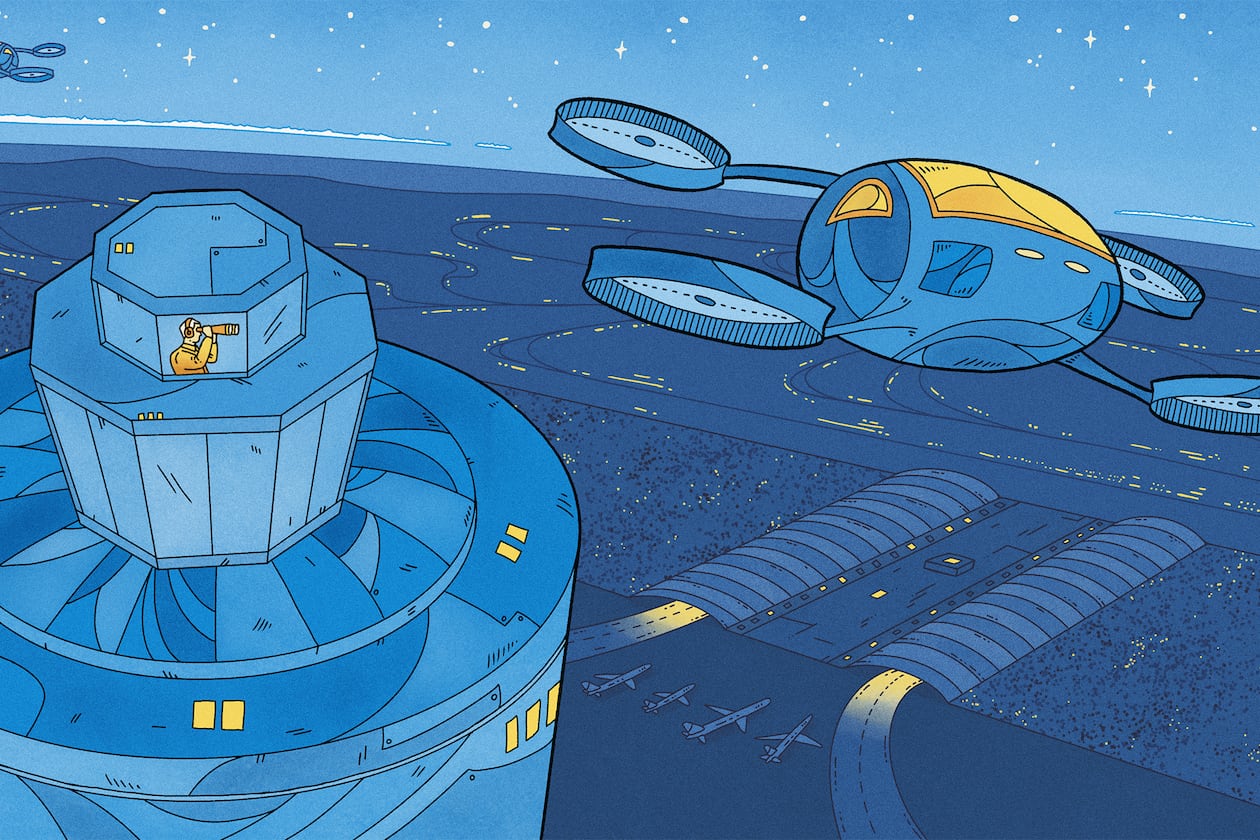
New air traffic control technology could improve flight frequency and allow the airport to squeeze in another runway; biometric systems could ease ID and security checks; self-driving cars could reduce the need for parking; flying air taxis could change the way people get to the airport.
The pressure for a second Atlanta airport could also ramp up.
In the meantime, leaders responsible for the world’s busiest airport are keeping all options on the table when it comes to the next century of its most valuable asset.
On to 160 million
When asked about the next century, Hartsfield-Jackson General Manager Ricky Smith, a veteran airport executive, said he isn’t planning by years. He’s paying attention to the ever-climbing projections of passengers.
Smith’s team is currently revisiting Atlanta’s 2015 master plan — which lasts until 2030 and an expected 121 million annual passengers.
Last year the airport saw 108 million.
The new master plan will consider what 160 million passengers might require, Smith said.
“Master plans don’t work well when they’re based on years,” he argued.
The existing plan proposes a new Concourse G on the international terminal and satellite Concourses H and I through a Plane Train extension.
A new runway could be needed at around 121 million annual passengers, it warns.

Credit: Hartsfield-Jackson Atlanta N
Credit: Hartsfield-Jackson Atlanta N
But today’s airport planners are not contemplating an expansion outside the existing fence line, Smith said. Any such expansion would inevitably displace communities and businesses and be costly.
“It’s a daunting challenge, but we’re trying to do everything we can within the fence line,” he said.
Unlike other airports that built broad land buffers like Denver or Dulles near Washington, D.C., Atlanta’s airport is “landlocked” by surrounding development.
Delta Air Lines CEO Ed Bastian said there’s plenty of room within its existing footprint.
Delta has a major say in what happens at the Atlanta airport, with control over about 80% of passenger volume with its partners.
Just look at an airport like New York’s LaGuardia, which has about 700 acres and where Delta just built an entirely new terminal, he said.
In the next century, all Hartsfield-Jackson expansion ideas — concourses, runways, terminals — need to stay on the table, he said.
“Things just continue to get more expensive and more complicated. But the only way you keep an airline prosperous and keep a city prosperous is through growth,” Bastian said.
“And so you have to be ready and willing to invest if you’re going to play here.”
Atlanta’s airport was designed to be grown with its modular layout of parallel runways and concourses, he noted.
“We’re not ready to make those decisions or announcements, but we know the potential exists for growth,” Bastian said at an Atlanta Press Club event where he and Smith spoke.

Credit: Hartsfield-Jackson Atlanta N
Credit: Hartsfield-Jackson Atlanta N
“If the time comes where we have to think about a new terminal, we’ll be up for it, and then work hand in glove with the city on it,” Bastian told The Atlanta Journal-Constitution in a separate interview.
Once Delta finishes the ongoing expansion of Concourse D in 2029, “it’ll enable us to think what’s next,” he said.
Discussions of growth at the Atlanta airport are exciting to many.
But they also aggravate worries left by past airport expansion, which some neighbors felt happened without much consideration for them.
“There are a lot of scars,” said Shannon James, CEO of Aerotropolis ATL.
Still, as a leading economic development voice for the region around the airport, he considers the question of airport growth to be “a good problem. I’m all for good problems.”
He said future conversations about expansion will be different.
“I think if we’re going to talk growth, then let’s talk about, yeah, there’s a (return on investment) at the end of the day for Delta. But there has to be (one) for our communities,” he said.
Democratic State Rep. Kim Schofield, who has spent nearly a decade representing communities around the airport, said she is “pro-growth, because it has to happen.”
“But I also want to make sure as it’s happening, we’re not erasing our legacy and our community,” she said.
“I think there’s not an either/or, but there is an ‘and’ in this next 100 years. There’s and we can do it, and we can be better, and we will be better.”

‘Stuff’s going to break’
Before Atlanta gets to a new runway or more concourses, there’s a lot on the to-do list, General Manager Smith said.
“We’re at a point now where pretty much all of our major amenities, our parking facilities, the restrooms, the concourses, the checkpoints, the baggage facilities — they’re all stretched, and that’s at 108 million passengers,” Smith told the Press Club crowd.
Looking ahead to even 125 million passengers, he said, “a lot of stuff’s going to break before we get there.”
The Plane Train, escalators and elevators could also struggle to keep up. So could the airport’s information technology infrastructure.
“And so we have to really take a serious effort around master planning to determine what all of our facilities need to look like and the costs associated with that,” he said.
Bastian agreed that the airport needs upgrades: “I know the mayor feels strongly about this. I feel strongly about this. We need to upgrade and update the amenities and the concessions to make it a much more welcoming environment in the airport.”

Credit: Miguel Martinez-Jimenez
Credit: Miguel Martinez-Jimenez
Outgoing City Council President Doug Shipman said constituents often bring up the physical state of Hartsfield-Jackson compared with some of its gleaming airport peers.
People tell him, “‘Gosh, I go to other airports and I see these new things, these interesting things. Have you seen the new LaGuardia terminal? My goodness!’”
Meanwhile in Atlanta, he hears complaints that it seems like “we … still have the same concessions that we’ve had for a while,” he said.
Indeed, the last broad overhaul of Atlanta’s concessions was in 2012. Several reasons are to blame, including a corruption investigation, contracting issues and COVID-19.
Delta has, meanwhile, invested billions in key airport hubs, including Minneapolis, Salt Lake City, Los Angeles, Boston and LaGuardia and John F. Kennedy International in New York.
The COVID-19 travel lull enabled them to speed some of that construction up, Bastian said. But in Atlanta, “we didn’t have that luxury. Atlanta wasn’t down as much.”
“Like I told Ricky (Smith) when he came here, it’s a little bit like being from New York. We’ve got lots of bridges in New York. And you’re not going to build a new bridge but you’ve got to continue to paint and repair that bridge. It’s the same mindset here,” he said.

Credit: Miguel Martinez
Credit: Miguel Martinez
A second airport? EVTOLs?
One thing that seems to be off the table for Atlanta or Delta officials, even in a new century, is a second airport.
Atlanta and Delta have for decades fought to protect the airport’s singularity. Atlanta remains the largest metro area in the U.S. with only one commercial airport.
Smith called it a “premature discussion” and said the focus should remain on planning at Hartsfield-Jackson.
Bastian said he doesn’t even worry about the possibility.
“Any entity that’s willing to put capital at risk to build another airport to compete against Atlanta in Atlanta’s backyard, that’s a high-risk maneuver,” he said.
A second airport would divert resources and passenger volume, Delta and the city have warned.
Bastian said he sympathizes with the residents of northern metro Atlanta for their airport commute.
“I’ve got a home in Gwinnett County,” Bastian said. “So I understand the traffic becomes a challenge and proximity becomes a challenge.”
But the convenience of an airport, he argues, isn’t in the time it takes to get there: “It’s the scale of the destinations and the schedule capability and the frequencies.”
He has a different vision for how best to improve access to Hartsfield-Jackson: eVTOLs.
Delta has been an early supporter of “electrical Vertical Takeoff and Landing” aircraft.

Credit: arvin.temkar@ajc.com
Credit: arvin.temkar@ajc.com
In 2022, the airline invested $60 million into air taxi startup Joby Aviation, with which it plans to begin operations in New York and Los Angeles “in the years ahead.”
These quieter aircraft rise like helicopters but fly horizontally like planes to enable faster and closer air connections. Dubai plans to launch commercial service next year.
Rather than building a whole new airport, Bastian said, the answer is ‘vertiports’ in northern Atlanta communities to ferry people down to Hartsfield-Jackson.
James with Aerotropolis ATL shares this vision. If Dubai is doing it, “why not us?”
He hopes to leverage the need for vertiports near the airport for the benefit of his communities like East Point, College Park and Hapeville.
People could fly in directly from Roswell, Cobb or Dahlonega, he said.
While Delta also has hopes to land eVTOLs directly on the roofs of Sky Clubs, James wants to make sure his community isn’t bypassed by the new technology.
“We’ve been bypassed for decades. It’s about making sure that they recognize that we’re watching, we’re at the table and we need to be a part of the discussion,” he said.
In about a year he hopes to be in the final stages of identifying an eVTOL route for a pilot with Delta, Atlanta and federal and state officials.
Smith, the airport executive, is more skeptical of air taxis, given how quickly aviation changes.
“It’s hard to predict whether eVTOLs (are) going to be something transformative or not. We’re not going to over plan or overcommit,” he said.
Autonomous vehicles on the other hand, including passenger and baggage transport, are very much a part of their planning, he said.

Credit: arvin.temkar@ajc.com
Credit: arvin.temkar@ajc.com
Bastian remains confident eVTOLs will someday come to Atlanta.
“The story of the airport here is one of evolution, not revolution,” Bastian said. “It’s not incrementalism. It’s thinking big, but we need to work in partnership.”
And something is just as clear to Council President Shipman as it was to Atlanta leaders in 1925: “This is the lifeline, in many ways, for the city,” he said.
“It almost makes it like a harbor city, except we don’t have any water. The harbor is the airport.”
Just like the Savannah port serves as a major economic driver that requires constant investment, he argues, “The airport is not just the airport.”
“It multiplies in so many ways. For the next 100 years, it has to maintain a very central focus.”
This is the final story in the Atlanta Journal-Constitution’s series of stories to mark the 100th anniversaries of both Delta Air Lines and Hartsfield-Jackson Atlanta International Airport.
About the Author


Keep Reading

The Latest

Featured