


COLUMBUS — In many ways, the Voting Rights Act not only helped define the contours of Georgia state Sen. Ed Harbison’s political life — it made it possible.
The Columbus Democrat grew up in segregated Montgomery, Alabama, where the idea of any Black person in an elected position was unfathomable. He was a teenager during the Montgomery Bus Boycott and remembers his mother, who earned roughly $3 a day working as a maid in white families’ homes, walking to work or pooling money with others for cab fare rather than hurt the campaign to end segregation on public transportation.
“The Civil Rights Movement was akin to religion in the Black community,” Harbison recounted in a recent interview. “The mothers and the fathers of that generation were willing to pay the price for their children to be better than they.”
He remembers the jubilation he felt when he received his first voter registration card and the slow hiring of African Americans to public-facing roles: Montgomery’s first Black bus driver, the earliest Black policemen, the first African American sheriff in Tuskegee.
Harbison would move to Georgia and eventually climb his own way up the political ladder, culminating in his election to the state Senate in 1992.
Now the chamber’s longest-serving member, the 84-year-old Harbison said the U.S. Supreme Court’s recent ruling gutting much of what remained of the Voting Rights Act is a “wake-up call.” He said the moment requires a return to the political unity that marked his childhood.
“We need to reignite that fuse,” said Harbison, who is set to retire at the end of the year.

Credit: Arvin Temkar/AJC
Credit: Arvin Temkar/AJC
The Voting Rights Act fundamentally remade politics and elections in Georgia.
It greatly expanded who got to vote, blocked scores of proposed local and county-level voting changes that could have dampened minority voter participation in Georgia and provided voters with a pathway to challenging discriminatory political maps. It paved the way for the creation of majority-minority voting districts and the state’s first Black elected officials since Reconstruction. Before the VRA, Georgia had sent only one Black person to Congress. Since then, it’s elected 11.
While the Supreme Court’s decision in Louisiana v. Callais didn’t kill the 1965 law outright, experts say it will significantly narrow the legal avenues available for voters who believe districts are drawn to disadvantage minority voters. And it comes on top of previous rulings that have already toppled other pillars of the landmark statute.
The ruling is expected to prompt a major redistricting of Georgia’s congressional and legislative maps, starting with a June 17 special session of the General Assembly. Many observers are predicting a fundamental realignment of political power in Georgia.
“It could be a free-for-all,” said Joseph Bagley, a history professor at Perimeter College who studies civil and voting rights litigation.
Many Black leaders are voicing concern that generations of gains could be wiped out practically overnight, hampering their community’s voting power for years to come.
“It’s going to make it harder for us to be able to hold office with the type of gerrymandering that (Georgia Republicans) are trying to pass,” said Gwenette Westbrooks, president of the Georgia NAACP.
Republican leaders, meanwhile, have largely written off those concerns as little more than Democratic posturing. They’ve suggested the Voting Rights Act did its job of ending institutionalized racial discrimination in elections and is now largely unnecessary.
“Georgians deserve fair districts that reflect the will of the voters — not artificial racial quotas or outdated mandates that divide our state along racial lines,” said Josh McKoon, chairman of the Georgia GOP, in a statement after the governor announced a special session. He said districts should be redrawn to be “race-neutral.”

Credit: Jason Getz/AJC
Credit: Jason Getz/AJC
‘Drawn to silence us’
The ruling is expected to have significant implications on the ground in Georgia in the years to come.
Republican leaders have yet to release their proposed maps for the state’s congressional and legislative districts. The Georgia Legislative Black Caucus is the largest caucus of Black state lawmakers in the nation, but its leaders expect many in their ranks could lose their seats.
“We can expect the worst,” said state Sen. Nikki Merritt, D-Grayson, who chairs the group, at a recent news conference. “I don’t have faith that this body is going to deliberate in a way that’s fair, in a way that’s just and in a way that listens to the voices of Black people.”
An area of the state that’s expected to see major shifts is Georgia’s Black Belt, which stretches from Columbus to Augusta. Harbison’s seat could be redrawn, along with other majority-Black House and Senate districts in the area.
Representation in Washington is also expected to shift. The Congressional Black Caucus recently estimated it could lose up to one-third of its 58 members because of redistricting in statehouses around the country.
At least one of those U.S. House seats could come from Georgia. Republicans have long made clear their desire to claim the southwest Georgia district held by veteran Democrat U.S. Rep. Sanford Bishop. The GOP could also try and redraw some of the four metro Atlanta House seats occupied by Black Democrats.
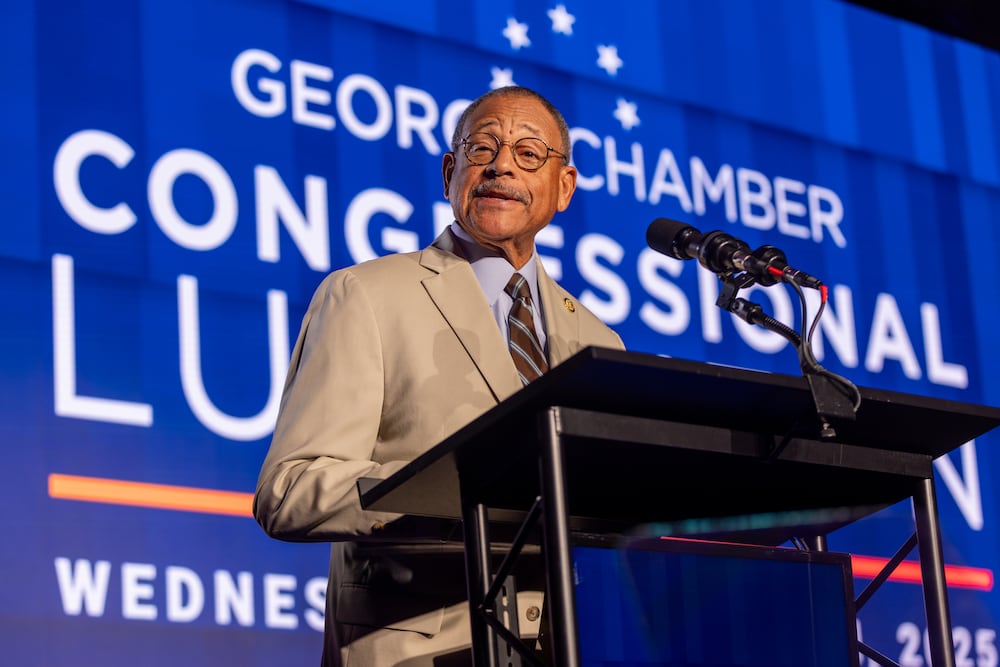
Credit: Arvin Temkar/AJC
Credit: Arvin Temkar/AJC
Many of those officeholders had strong words about what any dismantling of majority-minority districts would mean.
“Those lines will be drawn to silence us,” said state Rep. Doreen Carter, D-Lithonia.
Republicans say they are not looking to target Black voters, but Democrats in general, and the new Supreme Court ruling protects partisan redistricting. But given that race typically aligns closely with party affiliation, that could have the effect of more white Republicans being elected to represent communities of color that typically support Democrats.
House Minority Leader Carolyn Hugley, D-Columbus, said important perspectives are lost when lawmaking bodies become less diverse.
“If you’ve never been part of an excluded class, you don’t think about that” as you’re drafting legislation, she said.
Moving away from race?
Camilla Moore sees things differently.
The chairman of the Georgia Black Republican Council, Moore said the Voting Rights Act was desperately needed when it was passed. But 61 years later, political realities have shifted.
“It’s not about race necessarily anymore,” she said. “It’s more about party.”
The country is ready to move past using race as a barometer for political representation, according to Moore. She said the Supreme Court’s ruling gives her party an opening to make inroads with Black voters by leaning on what she described as shared “biblical principles.”
“At some point, we do have to get to a colorblind society,” she said. “I know it’s going to be a struggle to get there, but I just think that in the Black community, we have to say who truly represents our values.”
Moore said the GOP has in the past written off Black voters since they often support Democrats, but she sees real potential, particularly with voters under the age of 45.
“You have a younger generation that does not want to be boxed in,” she said. “They want to be treated fairly. If racism raises its head, they’re going to have an issue. But their initial viewing point is not from a perspective of race; it’s more from perspective of economics, entrepreneurship, independence and how do they thrive and survive.”
Nate Williams of Atlanta Young Republicans said redistricting and the creation of new, more diverse political districts give conservatives an opportunity to show Black voters what they have already accomplished at the helm of state government.
“I do think a lot of it is a marketing issue,” he said. “In this state, we invest heavily in education. … We’re building more public hospitals that are being funded by Georgia. Those are things that have gotten done under the Republican Legislature.”
The next generation
As districts get redrawn, Democrats fear there will likely be fewer opportunities available for the next generation of Black leaders.
“It’s legislative seats, it’s city council seats, it’s school board seats,” said Hugley. “A lot of young people start at that level.”
In Columbus, Marquese Averett is at the forefront of that next generation. In his mid-30s, Averett has been involved in Democratic campaigns and political organizing since he was a teenager, working on issues like police violence, voting rights and the environment and boosting the candidacies of everyone from Barack Obama to Teresa Tomlinson, Columbus’ first female mayor.

Credit: Miguel Martinez/AJC
Credit: Miguel Martinez/AJC
This year, he is the Democratic nominee for an open, safely Democratic statehouse seat. But some in the party worry that district, House District 140, could be redrawn.
“There’s a whole generation of young people that are potentially about to be written out,” Averett said in a recent interview in downtown Columbus. “There’s a whole generation of young people who may never get the opportunity to serve their communities in its full capacity.”
About the Author



Keep Reading

The Latest

Featured
