Today’s newsletter highlights:
- Trump cancels housing bill-signing ceremony.
- Rick Jackson’s campaign stays quiet after primary win.
- Shanette Williams endorses Jon Ossoff.
Money matters

Credit: Jason Getz/AJC
Credit: Jason Getz/AJC
Rick Jackson has spent the past four months arguing a state law that lets a few powerful incumbents raise unlimited campaign cash is unconstitutional. But that doesn’t mean he won’t use it for himself.
Last week, he opened his own leadership committee now that he is the Republican nominee for governor. These committees don’t have contribution limits, allowing candidates to hoard huge piles of cash.
Jackson couldn’t have one of these committees during the primary. But his GOP opponent, Burt Jones, could because he was the sitting lieutenant governor. Jackson argued that gave Jones an unfair advantage, and a federal appeals court agreed with him.
Jackson is one of many candidates to challenge this law, and several judges have ruled it is likely unconstitutional. But the cases have never made it to a final ruling for a variety of reasons. In some cases, candidates ended up dropping them after the primary election.
The billionaire healthcare executive appears to have the financial resources to break that trend. Jackson could keep his lawsuit going and get a final ruling from the courts that could end the predictable parade of lawsuits during contested primaries of statewide offices. But it’s not clear if he will.
That’s because the law allows the Democratic and Republican nominees for governor to open leadership committees. Democratic nominee Keisha Lance Bottoms already has one. Now, so does Jackson.
“Our successful lawsuit fought unfair use of a leadership committee — where one candidate can raise unlimited dollars and others can’t,” Jackson campaign spokesperson Brian Robinson said. “In this (general) election, Rick’s opponent also has a leadership committee and everyone is on a level playing field.”
Things to know

Credit: Justin Tran
Credit: Justin Tran
Good morning! Here are three things to know for today:
- Georgia voters rejected three party-switching candidates in this year’s primaries, showing party labels still matter, Sophia Eppley reports.
- Now that Jackson is the Republican nominee for governor, his next challenge is to unite a fractured party still bruised from a brutal primary fight, Greg Bluestein reports.
- Georgia’s special legislative session that ended Tuesday ensures a bitter fight over voting machines will continue for another two years, Caleb Groves reports.
Housing bill bust

Credit: AP Photo/Jose Luis Magana
Credit: AP Photo/Jose Luis Magana
U.S. Sen. Raphael Warnock was ready to celebrate a rare Washington achievement on Wednesday: passage of a truly bipartisan bill to address runaway housing costs.
But President Donald Trump abruptly canceled the bill-signing ceremony, saying he would not sign it into law unless Congress also passes an election bill that would require people to show a photo ID to vote in federal elections, among other things.
It was a dramatic turnaround for Trump, whose administration had previously celebrated the housing bill’s passage. It irked Warnock, who authored a provision in the bill to limit the number of single-family homes that corporations and private equity companies can own.
“Somebody ought to tell the President of the United States that he is a temporary resident of public housing,” Warnock said. “It’s not his house, and he ought to get focused on making sure that the American people can buy a house and can afford rent. He ought to think about us for a change.”
The Senate on Wednesday night took steps to appease Trump on another issue, reversing course on a war powers resolution intended to pressure him into pulling out of the war in Iran. Trump celebrated the vote on social media but did not announce any change in stance on the housing bill.
With the Senate now in recess through July 13, Trump is in no mood to bargain and, with midterm elections looming, the fate of the housing legislation is unclear.
The Atlanta Journal-Constitution has reported extensively on how the proliferation of investor-owned properties have contributed to high prices and fees, evictions and substandard conditions in Atlanta communities, especially Black neighborhoods.
Low profile
Some candidates make a splash after clinching the nomination. Jackson has taken a quieter route.
Over the last week, newly minted U.S. Senate nominee Mike Collins has publicized many of his moves: meeting with Gov. Brian Kemp at the Capitol, rallying activists at the Georgia GOP rodeo in Perry and returning to Washington to cast congressional votes.
Jackson, meanwhile, has largely stayed out of the spotlight as his campaign for governor prepares for the general election. He’s had no public campaign events, rallies or town halls.
His aides say he has been working the phones, holding meetings and briefings, and laying the groundwork for what comes next. He had dinner with state legislators on Tuesday night, has an in-studio radio interview set for Thursday and plans a potential campaign stop Friday.
His Democratic opponent, Keisha Lance Bottoms, has kept up her own public schedule. She held a healthcare event the day after the primary and plans to join U.S. Sen. Jon Ossoff at a rally in Savannah on Saturday.
Privacy right

Credit: Miguel Martinez/AJC
Credit: Miguel Martinez/AJC
In the early 1900s, a life insurance company used a photo of an artist in a newspaper ad without permission. The artist sued, and the Georgia Supreme Court ruled in his favor, marking one of the first times a U.S. Court recognized a right to privacy.
More than 120 years later, Georgia’s high court is again revisiting the issue, this time weighing whether a judge can compel someone to disclose their personal medical records in a civil lawsuit.
In that case, a woman is trying to prove that her former romantic partner concealed a herpes diagnosis from her and ended up infecting her with the disease. She sued, but he has refused to turn over the records.
“I’m not aware of us having any cases … really considering a claim of this sort before,” Chief Justice Nels S.D. Peterson said last week.
Peterson and other justices worried that if the courts blocked disclosure of such records every time someone asserted a right to privacy it would “be incredibly destabilizing toward our civil justice system.”
The man’s attorney referenced the 1905 Georgia Supreme Court decision, arguing that the right to privacy is “derived from ancient law and its foundation is in the instincts of nature.”
Listen up

Credit: Miguel Martinez/AJC
Credit: Miguel Martinez/AJC
Today on the “Politically Georgia” podcast we unpack what Collins and Ossoff are saying about each other in the U.S. Senate race, and what those early attacks reveal about the campaign ahead.
You can listen and subscribe to “Politically Georgia” for free on Apple Podcasts, Spotify, YouTube or wherever you get your podcasts.
Have a question or comment for the show? Email us at politicallygeorgia@ajc.com or give us a call at 770-810-5297 and you could be featured on a future episode.
Personal endorsement

Credit: Arvin Temkar/AJC
Credit: Arvin Temkar/AJC
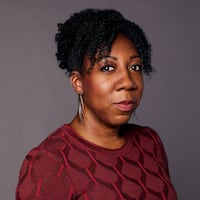
Ossoff picked up the endorsement of Shanette Williams on Wednesday. Williams became a political activist after her daughter, Amber Nicole Thurman, died in Georgia following complications from an at-home abortion in 2022. She made her announcement Wednesday on the fourth anniversary of the U.S. Supreme Court decision overturning Roe v. Wade.
While Williams’ endorsement isn’t unexpected, it highlights how Georgia’s abortion law is still impacting campaigns. Ossoff supports abortion rights, while Collins has said he is “100% pro-life, period, no exceptions.”
In her announcement, Williams said Ossoff frequently calls to check on her daughter’s son, Messiah.
“ (Ossoff) has taken the time to personally check on him, ask about his progress in school, celebrate his accomplishments, and encourage him through one of the most difficult periods of his young life,” Williams said. “He even made time for a play date with my grandson — something no headline would capture and no political benefit could be gained from.”
Today in Washington
- Trump will meet at the White House with House Speaker Mike Johnson and host a dinner for farmers.
- The House could vote on legislation related to gun sales and privacy rights.
- The Senate is in recess until July 13.
House blockade

Credit: AP Photo/J. Scott Applewhite
Credit: AP Photo/J. Scott Applewhite
A group of conservative lawmakers, including Georgia U.S. Rep. Andrew Clyde, have shut down the House floor in protest of the Senate refusing to pass an election overhaul measure.
The blockade means U.S. House Speaker Mike Johnson can’t get any substantive bills through the chamber. A crucial meeting with Johnson and Trump at the White House this afternoon could either end the impasse or solidify it.
In the past, Trump has personally convinced lawmakers to support Johnson and reverse course on blocking legislation from moving forward. But on the election bill, the SAVE America Act, he could back the protest.
Right now, House members have been told to stand by.
Shoutouts

Credit: Miguel Martinez-Jimenez
Credit: Miguel Martinez-Jimenez
Today’s birthdays:
- Garrison Douglas, a Republican communications consultant, who is joining Jackson’s campaign for governor as a spokesperson.
Transition:
- Ed Hula is the new communications director for the Atlanta City Council. Hula has previously worked as press secretary for U.S. Rep. Nikema Williams, D-Atlanta, and the Georgia Chamber.
Want a birthday shoutout in the Politically Georgia newsletter? There’s a form for that. It’s not just birthdays. We’re also interested in new jobs, engagements, birth announcements, etc.
Before you go

Credit: Arvin Temkar/AJC
Credit: Arvin Temkar/AJC
Kemp could have voided the election of Nikia Smith Sellers to a Fulton County judgeship. Instead, he appointed her to the position on Wednesday.
That’ll do it for us today. As always, you can send your best scoops, gossip and insider information to greg.bluestein@ajc.com, tia.mitchell@ajc.com, patricia.murphy@ajc.com and adam.beam@ajc.com.
About the Authors






Keep Reading

The Latest

Featured