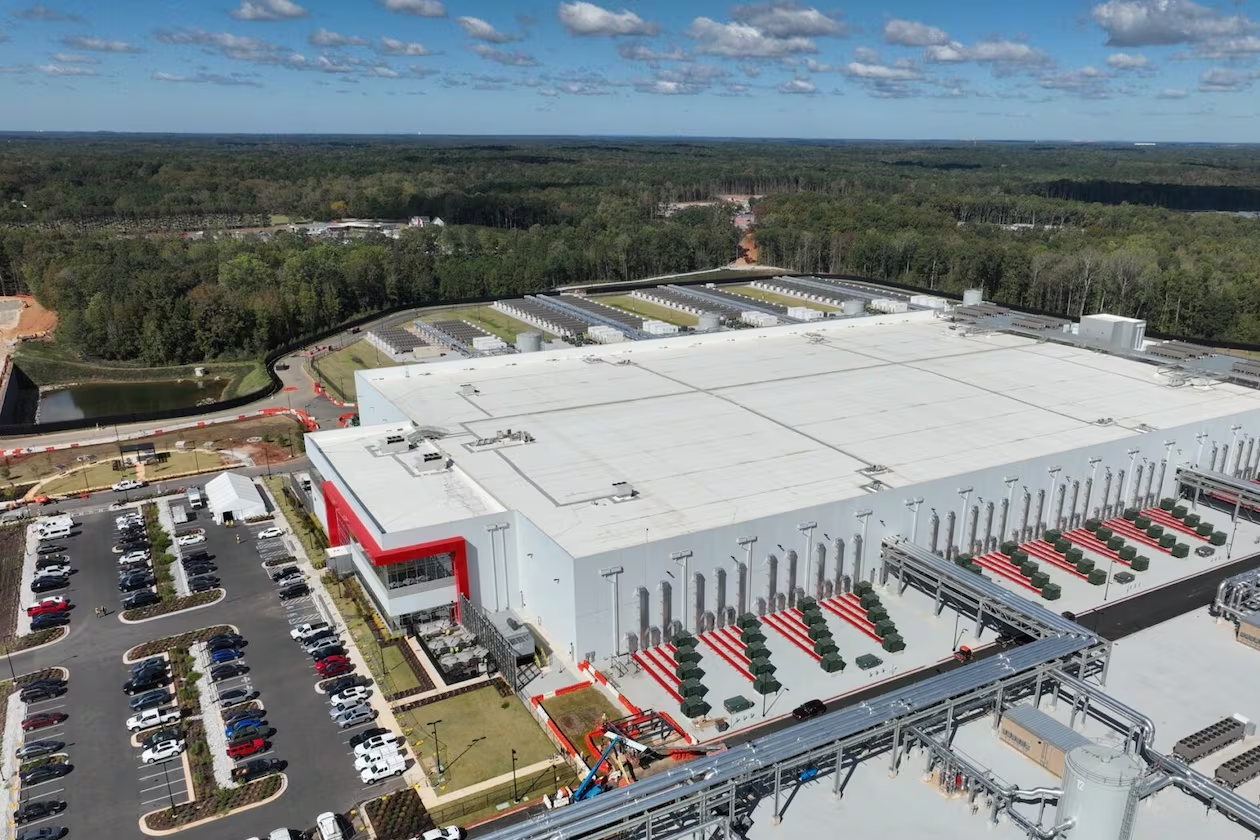
In a small southwest Georgia city that touts itself as “The Peanut Capital of the World,” a new proposal focuses on planting rows of something else: high-security computer servers.
Data center giant QTS plans to build up to 12 million square feet of server storage warehouses in Blakely, about 200 miles south of Atlanta, according to a state infrastructure review filing made public Tuesday. That expanse of floor space is more than seven Lenox Square malls or nearly twice the footprint of the Pentagon.
The project is in its early design stages and would be built in several phases, potentially including nine data center buildings and three electrical substations, according to a site map obtained by The Atlanta Journal-Constitution. It’s also one of the largest data center campuses conceived in the Peach State, which is already leading the country for the amount of server storage space under construction.
“Because planning is ongoing, power capacity, substations and electrical infrastructure are still being evaluated in coordination with utilities and local authorities, with any development occurring in phases aligned with grid reliability and community needs,” a QTS spokesperson said in a statement.

Credit: Daniel Varnado/For the Atlanta Journal-Constitution
Credit: Daniel Varnado/For the Atlanta Journal-Constitution
About 50 miles west of Albany, near the Alabama border, Blakely is entrenched in agrarian Georgia. With fewer than 5,200 residents, the city is the largest in Early County and competes with Dothan, Alabama, for the “peanut capital” title.
Georgia’s ascent to the country’s second-largest data center market has mostly been driven by large campuses around metro Atlanta and the northern half of the state. But the Blakely proposal is the largest to look southward.
It’s a trend experts say will likely continue as data center developers look for large sites with ample access to power infrastructure, even if the sites are farther from population centers.
“Have you been to South Georgia? Do you see any shortage of land?” Lynn McKee, the director of the commercial real estate program at Georgia State University’s Robinson College of Business, recently asked the AJC. “There’ll never be a shortage of land. … (But) how do we power this stuff? That’s the bigger issue.”

Credit: HYOSUB SHIN / AJC
Credit: HYOSUB SHIN / AJC
Details on the potential QTS site were made public this week in a Development of Regional Impact filing, a state infrastructure review required for large projects. Details in the filing are scant, but its next step is a local site plan review ahead of necessary rezoning and permit applications. The developer estimates it can complete the entire multiphase project by the end of 2035.
The potential QTS site is owned by McKnight-Blakely LLC, an affiliate of commercial real estate and hospitality developer McKnight Engler. It owns more than 2,332 acres around the Early County Airport, and the data center site map shows QTS is interested primarily in the land between U.S. Highway 27 and Magnolia Street.

Credit: Courtesy of City of Blakely
Credit: Courtesy of City of Blakely
John Engler, managing member of McKnight Engler, told the Early County News in November he first approached the city in mid-2024 about the potential of recruiting a data center to the property. Engler did not respond to a request for comment from the AJC.
Susanne Reynolds, executive director of the Early County Development Authority, said the prospect of a multibillion-dollar data center project could be a boon for residents.
“Data centers bring large investment to the area resulting in increased tax revenues,” she told the AJC in a statement. “This revenue, at the discretion of local leaders, can go towards addressing pressing issues for community members, including public works, community development programs and education.”
The estimated value of QTS’ Blakely project wasn’t unveiled, but it will likely be 10 figures. A 12 million-square-foot data center proposal by developer Trammell Crow Co. in the Middle Georgia city of Forsyth is estimated at $21 billion.
Data center developers often say their projects are gushers for new tax revenues, with some in rural areas projected to double or even triple local tax collections. These projects, however, sometimes receive property tax breaks that eat into those gains, and statewide tax exemptions on the computer equipment filling these hulking warehouses wipe out billions of dollars each year, according to recent Georgia audits.
Reynolds said QTS has not requested any property tax abatements or discretionary incentives from Blakely or Early County.
QTS is already in the process of building one of Georgia’s largest data center campuses in Fayetteville. It also has existing data center campuses in Atlanta and Suwanee, and it’s pursuing another project in Augusta.
The proposed Blakely data center campus is also projected to create “hundreds of permanent jobs,” according to QTS, which could help offset the loss of a Georgia-Pacific paper mill in nearby Cedar Springs, which closed last year.
The project will also include a “closed-loop” water system to cool its computer servers and limit evaporation, drastically reducing water usage compared to other common systems. With a closed-loop system, an average data center can use as much water as a few households each day rather than the millions of gallons per day other designs relying on evaporation often require.
About the Author




Keep Reading

The Latest
Featured