









Atlanta’s economic development arm on Thursday agreed it would provide a tax break to support the first phase of a new live-work-play development near Piedmont Park and the Beltline.
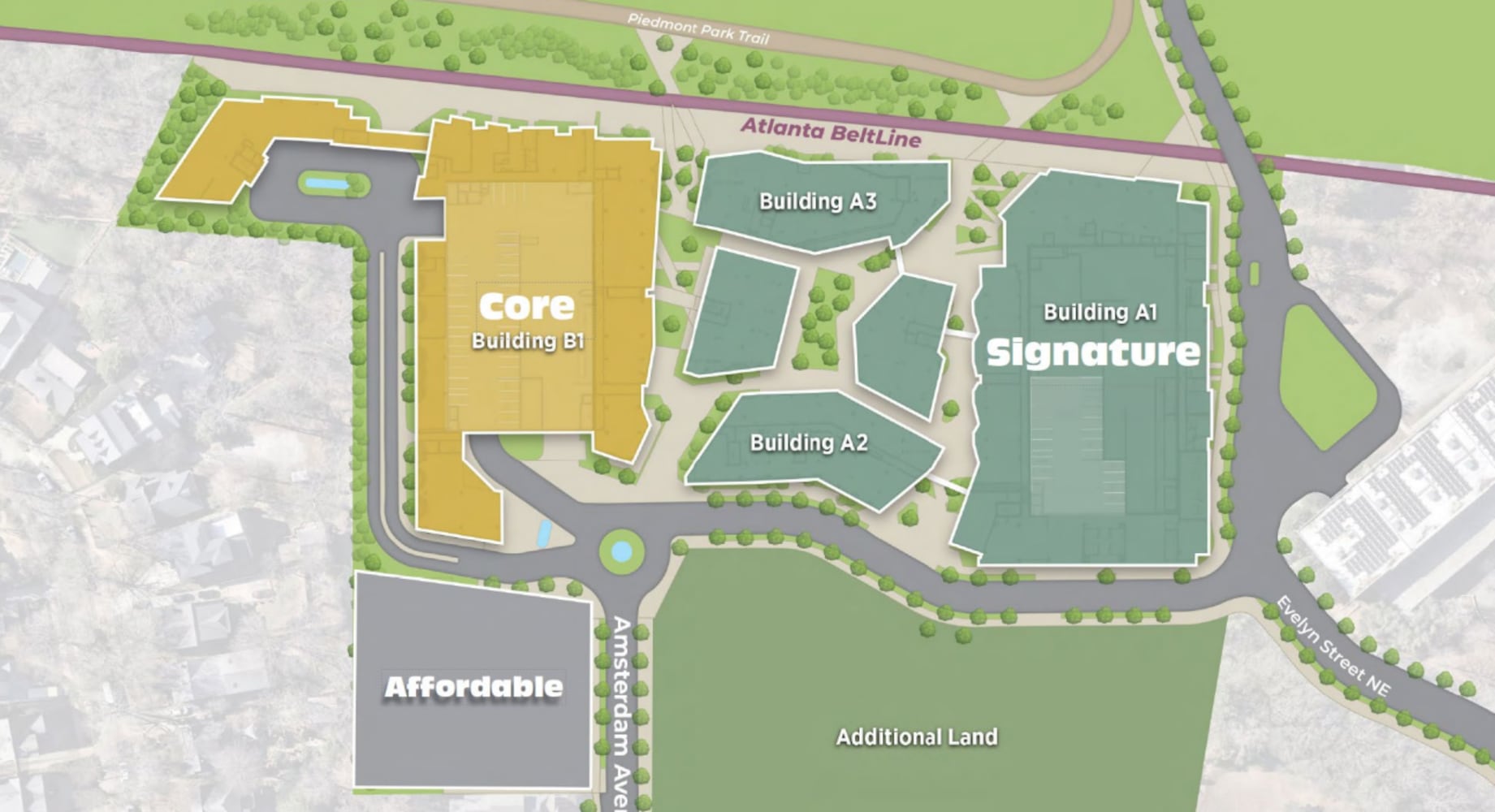
The Invest Atlanta board voted 6-2 to give the initial green light to an incentive package that focuses on Amsterdam Walk’s first apartments. The request by developer Portman Holdings includes a nearly $15 million tax break to help cover the cost of preserving 39 of 539 apartments — about 7% of those units — at rents below market rate for 99 years, according to documents filed with Invest Atlanta. A Portman official said during Thursday’s board meeting the agreement would actually lock in affordability for near two centuries.
The request thrust Amsterdam Walk back into the spotlight after its rezoning process garnered controversy over the project’s density and scope. Atlanta City Council approved the rezoning by an 8-6 vote in April 2025. Portman officials have argued the 11-acre site on prime real estate is a rare opportunity for a new Beltline node, while a grassroots opposition group said the redevelopment would only burden its surrounding neighborhoods.
Portman declined to comment ahead of Thursday’s meeting. Mike Greene, Portman’s managing director of mixed-use, told the board the affordability aspect for the overall project’s first phase “is significantly above and beyond” city requirements.

Credit: Courtesy of Invest Atlanta
Credit: Courtesy of Invest Atlanta
Portman first proposed its revamp of Amsterdam Walk in 2023, intending to raze the aging warehouses to build a more dense and vertical project centered on apartments. The plan has undergone multiple tweaks, including lowering the tallest building height from 17 stories to nine.
The property was zoned for dense commercial use, not residential, which is why Portman sought the rezoning to allow hundreds more apartments than it was zoned for at the time. The prior zoning allowed for only 330 apartments but up to 750,000 square feet of commercial space, including office towers.
Neighborhood Planning Unit F, which includes the site’s surrounding neighborhoods of Morningside-Lenox Park and Virginia-Highland, voted 77% against endorsing the proposal last year. The project also received a recommendation to deny or no recommendation from other city boards intended to advise the council ahead of rezoning votes.

Credit: NATRICE MILLER
Credit: NATRICE MILLER
The rezoning allows for up to 1,100 apartments as part of nearly 1.2 million square feet of total development. Of the total apartments, Portman said at the time that between 220 and 240 will be reserved for affordable housing at below market rate, in addition to reserving about 13% of the project’s retail spaces at a 30% discount for tenants.
The request of Invest Atlanta centers on the first apartment phase of 539 units, which Portman estimates is a $327 million project. Portman said the incentives help justify reserving 39 units at rents affordable for residents who make up to 80% of the area median income — $64,000 for an individual or $91,360 for a family of four.
Portman estimates it will lose more than $225 million in potential rent over the 99 years it agreed to preserve those units’ rents below market rate. Both Greene and Invest Atlanta staff said the property’s title includes a land-use restriction agreement that locks in the affordability component for 198 years, both for the apartments commercial spaces.
Last September, Invest Atlanta granted $19.3 million in tax-exempt bond financing and a $2 million grant from the Beltline’s Tax Allocation District for 135 additional multifamily units as part of Amsterdam Walk’s first phase. Those units will be reserved for residents making between 50% and 80% of the area median income or less.
Greene said the two Invest Atlanta requests, although separate on paper, combine to make the affordability plan work. Between those buildings, 25% of the residential units are below market rate, when city code requires only 20%.

Credit: Courtesy of Invest Atlanta
Credit: Courtesy of Invest Atlanta
Charlie Kaften, one of the opposition movement’s organizers, told The Atlanta Journal-Constitution on Tuesday the redevelopment plan includes too much density and too much car parking and will turn Monroe Drive into a parking lot. He told the Invest Atlanta board Thursday the affordability aspect also won’t dent Atlanta’s affordable housing shortage, while shifting future tax burdens to residents.
“If you give property tax breaks to developers, that means less revenue for the city,” he said. “And eventually, it will trickle down to taxpayers, citizens footing the bill.”
Jacinta O’Sullivan, another project opponent, told the board that Portman’s profits aren’t public because they are a private firm.
“Yet they have the audacity to come begging and pleading that they need tax incentives,” she said.
Despite the controversy leading up to the vote and Amsterdam Walk’s status as one of Atlanta’s largest redevelopment efforts, the project hasn’t generated much attention since the spring of 2025. The only substantive update was in May, when Portman filed a site plan with Atlanta’s Department of City Planning, which was reported by Urbanize Atlanta.
The filing detailed the project’s first phase, which includes replacing a majority, if not all, of the current Amsterdam Walk buildings with five new buildings, including two wrapped around parking garages. The plan also includes 11 pedestrian connections to the Beltline and more than 100 bicycle parking spaces. The second phase was not detailed in the filing but is slated to abut Highland Park Lane.
This week’s documents filed with Invest Atlanta say the project’s first phase will be delivered in 2029. The project’s second phase is still being designed and finalized, Greene said.
Clyde Higgs, head of the Atlanta Beltline, added that the agency will sell Portman 2.5 acres at appraised value as part of the Amsterdam Walk project, which includes the same affordability contingencies.
“If you start to amortize this over years,” Higgs said, referencing the accounting method of gauging an asset’s intangible value over time, “we’re going to look like geniuses if you look at this 20 years from now.”
Editor’s note: This story has been updated with details from Thursday’s Invest Atlanta board meeting.
About the Author




Keep Reading

The Latest

Featured
