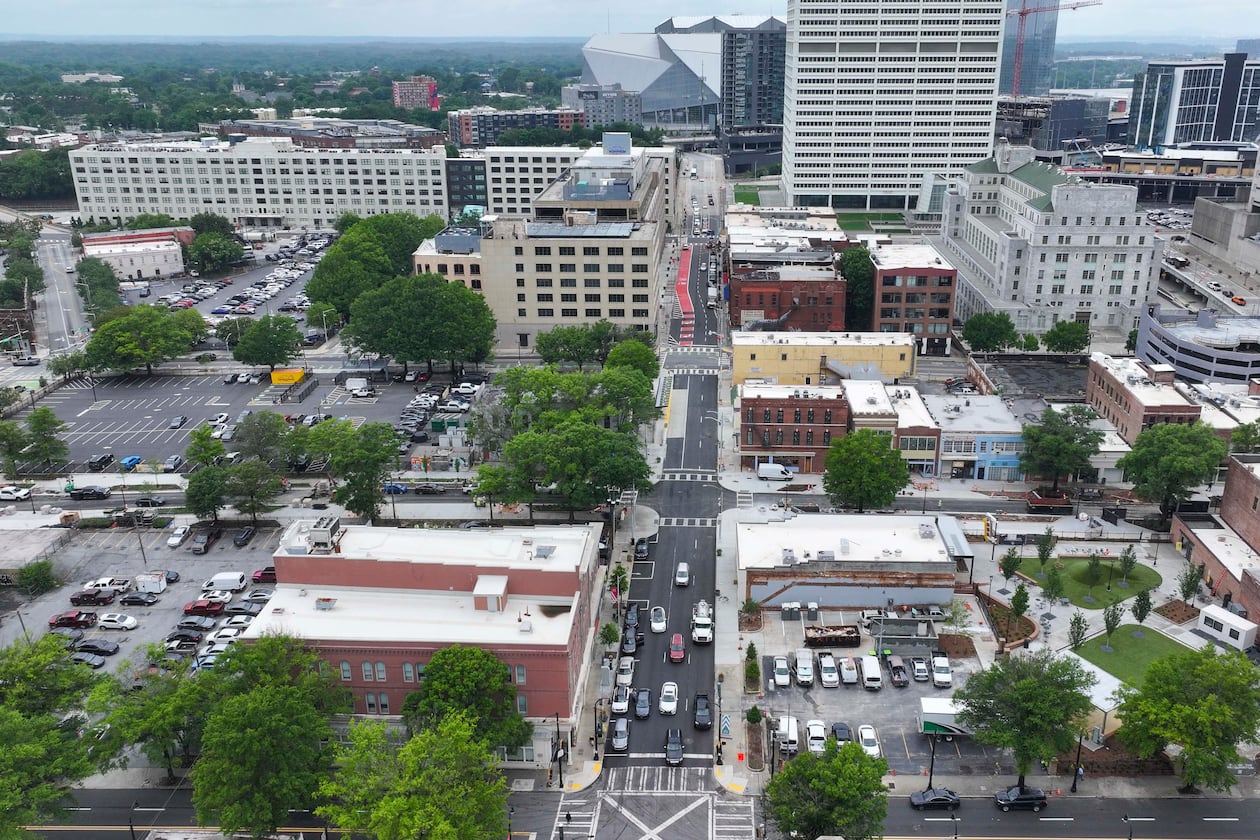
South Downtown has been a whirlwind of construction in recent months to get ready for the World Cup, but it’s about to switch from offense to defense.
The owners of dozens of historical buildings in the 10-block neighborhood say they’ve pumped $140 million into renovating many of them, turning some into new restaurants, shops, startup offices, residential lofts and other gathering spaces. The World Cup acted as South Downtown’s debut, packing the area with traveling fans and locals taking their first look at downtown Atlanta’s next era.
Now that the soccer crowds have left, South Downtown’s owners said the project team is taking a pause to evaluate what is sustainable going forward. It involves halting new development for the next year and laying off four project managers, shifting focus from construction to managing the operations already in place and trying to lease the renovated spaces.

Credit: Miguel Martinez/AJC
Credit: Miguel Martinez/AJC
The shift in strategy aims to gauge the area’s market appeal post-World Cup. The developers said they will also use this time to determine what the group might build in later phases. That could include housing, more offices and retail, whether in other historical buildings the investors own or ground-up construction on land they control.
“It’s not the sexy part, but we have to be patient now,” Jon Birdsong, one of the tech investors in charge of South Downtown, said Tuesday.
Downtown is undergoing an unprecedented amount of development, including redevelopment of the Gulch into Centennial Yards and an overhaul of the former CNN Center, which is a lot for shoppers, workers and residents to absorb.
“We’ve been incredibly impatient and have an immense bias toward action,” Birdsong said of the development rush before the World Cup. “But now we need to flip the script and be patient.”

Credit: Olivia Bowdoin
Credit: Olivia Bowdoin
Lynn McKee, director of the commercial real estate program at Georgia State University’s Robinson College of Business, said not to underestimate “the power of a strategic pause.”
Much of downtown remains an unproven market for restaurants, apartments and neighborhood amenities, especially after the COVID-19 pandemic upended the office market, with fewer workers occupying downtown. McKee said taking a breath and seeing what works — and doesn’t — is prudent and could serve the area better in the long run.
“We’re ‘go, go, go’ kind of people in real estate,” McKee said. “We think that if we’re not building or buying that something is wrong. But I’ve learned that sometimes, particularly in the face of a lot of uncertainty, you are best to pause and let things unfold.”
Startup mentality
It probably shouldn’t be a surprise that an ownership group of tech investors would run South Downtown’s revitalization like a startup.
They appear to be following the typical startup playbook: Grow aggressively, quickly scale and then pivot or cut during market corrections before repeating the cycle. The post-World Cup pause was first reported by SaportaReport.
The entire operation centered around Mitchell Street is unconventional among large real estate projects, which is mostly because of the way Birdsong and his business partner David Cummings got involved leading the effort.
Between the Five Points and Garnett MARTA stations, South Downtown contains a rare cluster of ancient buildings left standing in Atlanta. Starting in 2016, German developer Newport RE began acquiring many of the area’s vacant buildings and parking lots in pursuit of a large redevelopment vision that was derailed amid the COVID-19 pandemic.
The portfolio of more than 50 buildings was on the brink of foreclosure when Birdsong and Cummings led a group of tech investors to purchase it in late 2023. The duo, known for founding Atlanta Ventures and Buckhead’s Atlanta Tech Village, haven’t disclosed how much they paid to acquire the portfolio, but they’ve said it was at a steep discount, and they financed it with equity rather than debt.
McKee said most real estate projects have debtors to pay and investors seeking annual returns, but lacking those provides the luxury of time to South Downtown.
“They’re not sitting on a big loan they’ve got to pay interest on or have a financial partner who has an 8% preferred return ticking every day,” McKee said. “They’re under no rush, like a typical real estate person.”
The World Cup, which included Atlanta as a prominent host city, acted as the project’s first immovable deadline. Birdsong said the $140 million budget acted as South Downtown’s first phase, delivering more than a dozen restaurants, offices for startups, 26 loft apartments, a private park and streetscape improvements.

Credit: Estela Muñoz/AJC
Credit: Estela Muñoz/AJC
The area was a hub for soccer festivities, but it’s not representative of typical downtown foot traffic. Birdsong said the World Cup was an opening party, but the following months will stress test the things they’ve built.
“We need to lease up all our live, work and play space before we get to Phase 2,” he said. “We don’t want to get out too far in front of our skis.”
An inflection point
South Downtown isn’t a project in isolation.
Just to the west, the $5 billion Centennial Yards minicity in the former Gulch is a hive of construction activity. The new owner of the former CNN Center, now known as The Center (stylized as The CTR), is also moving forward with a reimagining of the hulking mixed-use complex.
“Our downtown community was hit hard by the COVID years,” AJ Robinson, president of Downtown Atlanta Inc., the city center’s main civic organization, wrote in a recent AJC opinion column. “We are still dusting ourselves off and we needed the World Cup to give us a boost and launch us into another generation of development and growth.”
Many of those other large projects that were given a jolt by the World Cup are also shifting gears now that soccer crowds have left the city.
Centennial Yards plans to develop new apartments and hotels while completing its core entertainment district. Developer CP Group, which owns The CTR, has said it will pursue plans to convert some of the complex’s empty office towers into a hotel and apartments.

Credit: Arvin Temkar/AJC
Credit: Arvin Temkar/AJC
McKee said those projects in the shadow of Mercedes-Benz Stadium and State Farm Arena have a built-in customer base of eventgoers and tourists, but that might not extend to areas like South Downtown.
“Once you go down Mitchell Street and you’re in South Downtown, that’s a different world. And you go to Five Points, that’s a different world,” he said. “So even if you’re convinced that the area around Centennial Yards, The Center and Centennial Olympic Park are going to (thrive), that doesn’t necessarily spread east.”
Underground Atlanta, which featured viral gatherings of thousands of Argentina fans during the World Cup, is in the same boat, according to its owner, Shaneel Lalani. He recently told Urbanize Atlanta that financing for new construction is a challenge, adding that he’s also focusing on leasing the space he already has on the market.
“Without the government incentives, you can’t pencil in these deals,” he told Urbanize Atlanta. “Very rarely do you see a tower going vertical in downtown.”

Credit: Underground Atlanta
Credit: Underground Atlanta
As for South Downtown, Birdsong said his staff of 10 is keeping a close eye on daily retail sales to gauge what works. South Downtown’s first residential project, called 85 Peachtree, has leased six of its 26 lofts, and Birdsong said that will serve as a bellwether for how new residential projects proceed.
“We’re confident … there’s very good signals,” he said. “But we just won’t know until more time occurs.”
About the Author



Keep Reading

The Latest

Featured